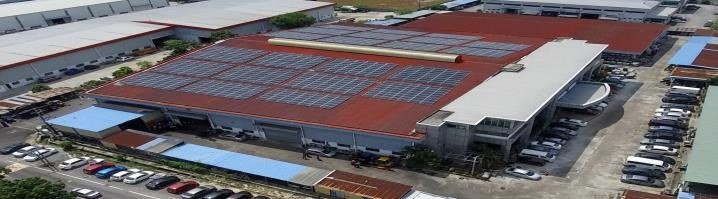
Solar ATAP explained for business owners
Malaysia's rooftop solar programme for business premises started on 1 January 2026. It covers shoplots and workshops on low voltage supply as well as factories on medium voltage. Learn what it allows, what it costs, and how it lowers your TNB bill.
What Is Solar ATAP
The Solar Accelerated Transition Action Programme
Solar ATAP replaced Net Energy Metering (NEM 3.0) on 1 January 2026. The Energy Commission sets the rules under guideline GP/ST/No. 60/2025, and SEDA Malaysia runs the applications.
The programme lets your premises generate its own electricity from rooftop solar, use it on site first, and export any surplus to TNB for a bill credit. It covers all TNB customer categories in Peninsular Malaysia, from shoplots to factories.
Which TNB Account Are You On
Your supply voltage decides how TNB charges you, and so what solar saves you.
Shoplots, offices, workshops, small factories
Formerly Tariff B (commercial) and Tariff D (industrial). Most bills show no Maximum Demand charge.
All three charges are billed per kWh, so solar used on site cuts every one of them. Size the system to your daytime usage.
Large factories, malls, cold storage, hospitals
Formerly Tariffs C1, C2, E1, E2 and E3. Capacity and network charges follow your Maximum Demand.
Solar cuts the energy charge. The RM89.27 per kW of MD stays unless your peak drops, and cloud cover makes solar unreliable for that. A battery targets MD.
General tariff rates for Peninsular Malaysia, effective 1 July 2025 to 31 December 2027, before AFA, KWTBB and SST. Source: Energy Commission tariff schedule.
How Solar ATAP Lowers Your Bill
Every kWh your business uses on site is worth more than every kWh it exports.
Your roof generates
Panels produce electricity through daylight hours, when most factories, offices and warehouses run at full load.
You use it first
Each kWh used on site is a kWh you no longer buy from TNB. On low voltage, this avoids energy, capacity and network charges. Most of the savings come from here.
Surplus earns a credit
Weekend and holiday surplus exports to TNB for a credit at the Average System Marginal Price, a lower wholesale rate.
What this means for sizing
Size the system to your daytime load, not your roof area. Oversizing sends more power to TNB at the wholesale rate, and unused credit expires every billing period.
What it does not change
Export credit offsets only the energy charge, never AFA or fixed charges. On medium voltage, MD-based charges stay unless your peak drops. A battery energy storage system targets MD, and Solar ATAP allows one.
Does Your Business Qualify
Eligibility rules for non-domestic premises.

How Big A System Your Site Qualifies For
Pick your supply voltage and enter the Maximum Demand from your TNB bill. No MD on your bill? Tick the box.
TNB study and SEDA application fees are included in our solution.
Discuss My SiteThe Rules In Detail
For non-domestic premises, from Energy Commission guideline GP/ST/No. 60/2025.
Up to 100% of Maximum Demand
Measured as inverter output, based on your average recorded MD over the past 12 months. Accounts without 12 months of recorded MD use the declared MD in TNB's records.
1,000 kW per installation
TNB's network study sets the final approved size, which sometimes sits below your MD.
Average SMP
The monthly average wholesale price between 7am and 7pm in the previous month, published by the Single Buyer by the 14th.
Capacity × 5 hours × billing days
Exports above this cap, or above what you import in the month, earn no credit.
Same billing period only
Unused credit is forfeited. Credit does not offset the Automatic Fuel Adjustment, and the bill never goes below zero.
Up to 10 years
After the period ends, the system keeps running for self-consumption. Carbon credits from the system belong to you.
Solar ATAP, SELCO Or NEM
NEM 3.0 closed at the end of 2025. In 2026 businesses choose between Solar ATAP and SELCO.
| SOLAR ATAP | SELCO | NEM 3.0 | |
|---|---|---|---|
| Status | Open since 1 January 2026 | Open | Closed to new applicants |
| Export to grid | Yes, credit at Average SMP | No, on-site use only | Yes |
| Size limit | 100% of MD, max 1,000 kW | Per SELCO guidelines | Replaced by Solar ATAP |
| Unused credit | Forfeited each billing period | Not applicable | Carried to next bill |
| Best fit | Sites with weekend or holiday surplus | Sites using all output on site, or above 1 MW | Existing contracts only |
How To Apply
Applications go through a SEDA Registered PV Service Provider on SEDA's eATAP portal.
Check eligibility and MD
Confirm your tariff category, 12-month MD record and premises type.
Appoint a registered provider
Only a SEDA Registered PV Service Provider submits Solar ATAP applications.
TNB technical study
A Connection Assessment Study for systems above 72 kW, or a Power System Study for high voltage.
Submit on eATAP
SSM documents, latest TNB bill, endorsed SLD and C&S drawings, and the study approval.
Approval and licence
SEDA decides within 2 months of a complete application and issues an e-Certificate. Systems above 72 kWac also need an ST generation licence.
Install and switch on
The system must start operating within 18 months of approval. Testing, the TNB bi-directional meter and the Solar ATAP contract come before ATAP billing starts.
How Businesses Pay For It
The Solar ATAP application recognises five financing models.
Outright Purchase or Bank Loan
You pay for the system and keep the full savings. Green investment tax incentives under MIDA's GITA scheme apply to some projects. Your tax advisor confirms eligibility.
Solar Leasing, PPA or a Hybrid
A registered solar investor funds the system. You pay per kWh used, or a fixed monthly amount, over an agreed contract period.
Frequently Asked Questions
Does Solar ATAP reduce my Maximum Demand charge?
My bill shows no Maximum Demand. How is my size limit set?
Is Solar ATAP worth it on low voltage?
Does a rented factory qualify?
What happens to my existing NEM system?
What happens if I sell or move premises?
What happens after the 10-year period?
Is there a quota?
Who submits the application?
Questions about Solar ATAP for your premises?
Tell us about your site. We check your eligibility, size limit and the right financing model, and reply within one working day.
Learn how Jana Bina Makmur helps business owners
+6017-368 5985 projects@janabina.com.my No. 25, Wisma SCMS, Jalan BP 7/12, Bandar Bukit Puchong, 47120 Puchong, Selangor